
Not every organisation should become a social enterprise. For some, it's the right strategy. For many, it isn't.
Across the sector, organisations are under increasing pressure to diversify revenue, reduce dependence on grants and generate earned income. Sometimes that's exactly the right strategy. Sometimes it's the fastest path to mission drift.
The challenge isn't finding commercial ideas. It's knowing whether a genuine commercial opportunity exists in the first place. More importantly, it's knowing whether pursuing it will strengthen the mission or distract from it.
The Social Enterprise Opportunity Index (SEOI) brings greater clarity to that decision. Not an ideation workshop. Not a business planning exercise. A structured diagnostic for better decisions.
What the SEOI measures
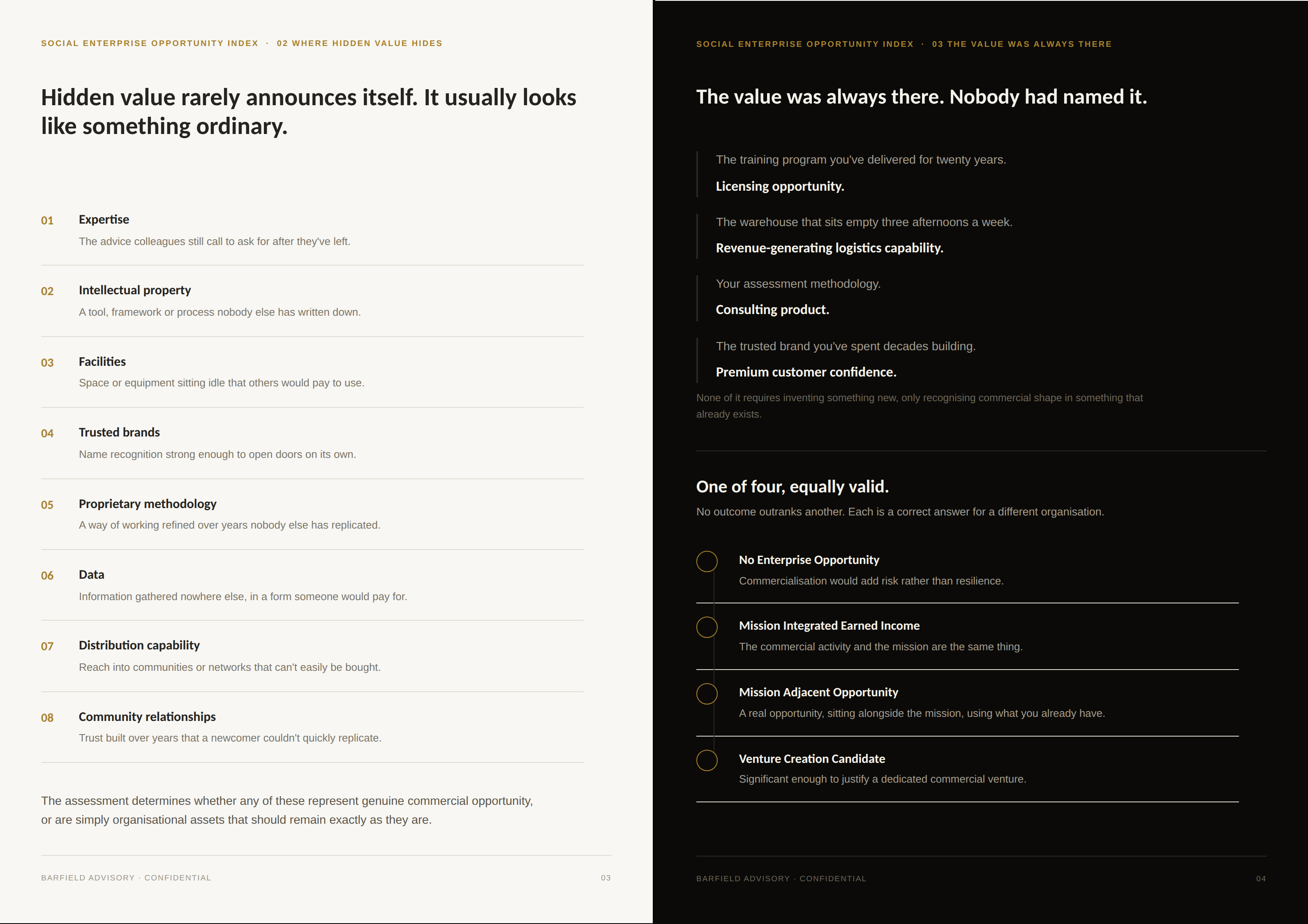
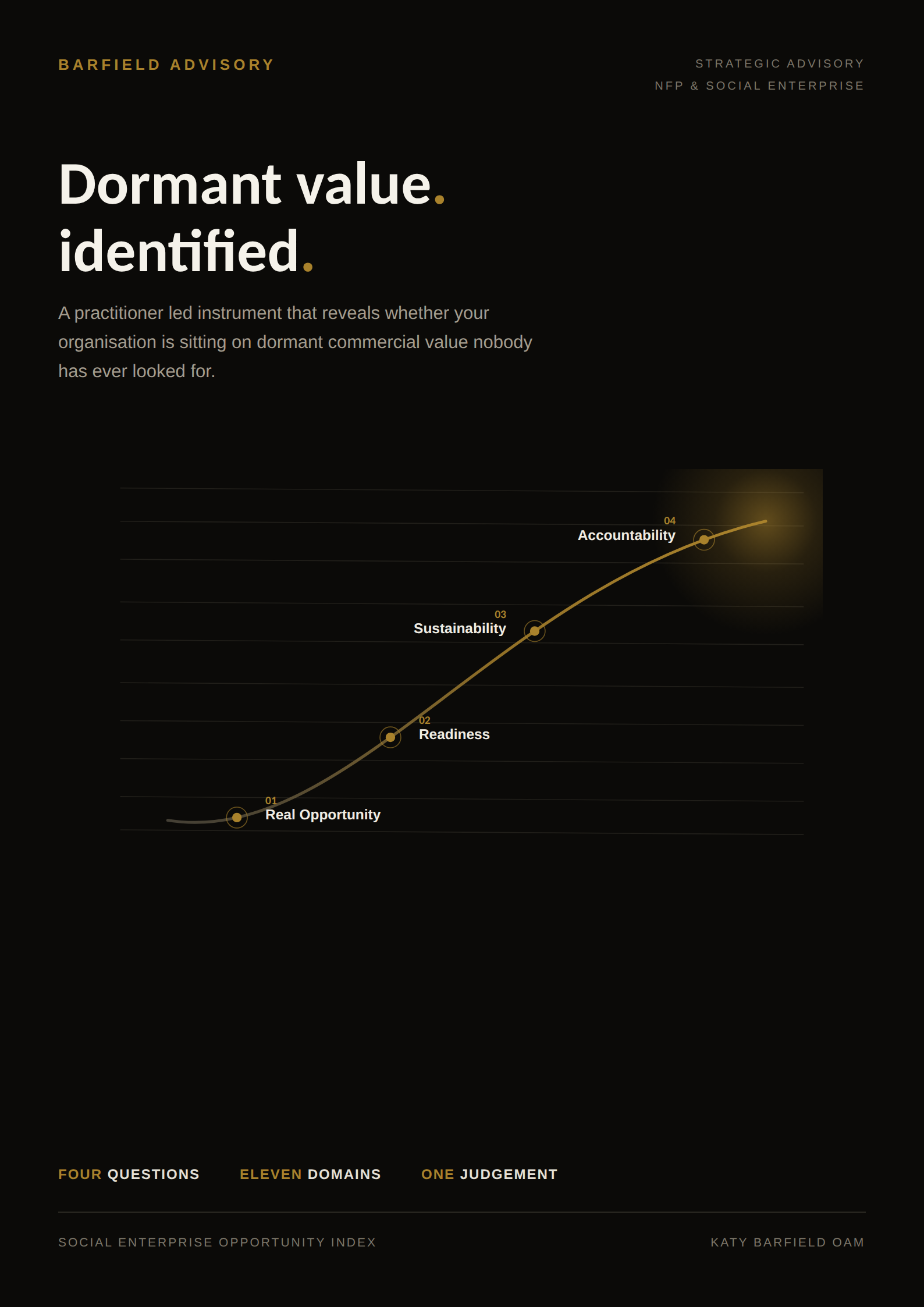
The Social Enterprise Opportunity Index assesses commercial opportunity across eleven independently assessed domains, grouped into four themes. Together they provide a comprehensive picture of whether an organisation has genuine, mission-aligned enterprise potential.
The framework looks beyond commercial ideas to assess the conditions required for sustainable, mission-aligned enterprise. It considers the assets an organisation already holds, whether a viable market exists, whether the conditions for success are in place, and whether commercial activity can strengthen rather than compromise the organisation's mission.
Like the OCI, the SEOI does not reduce this to a single score. Each domain stands on its own, ensuring significant strengths and critical risks remain visible throughout the assessment.
What makes the SEOI different
Many enterprise frameworks begin with the assumption that commercialisation is the answer. The Social Enterprise Opportunity Index begins with a different question: is commercialisation the right answer at all?
Built by practitioners who have spent two decades creating commercial value from overlooked assets, the SEOI is designed to identify organisations with genuine enterprise potential, while protecting those for whom commercialisation would create more risk than value.
It is grounded in evidence rather than optimism. Focused on mission before margin. Designed to uncover opportunity, not manufacture it. Designed to strengthen organisations, not persuade them to commercialise.
Who it's for
Understand whether a commercial opportunity is real and worth pursuing, before committing time, money and reputation to it.
Identify which organisations are genuinely ready for enterprise, so capacity-building capital is invested where it can have the greatest impact.
Move from instinct and optimism to a clear, evidence-based view of where genuine commercial potential exists, and where it doesn't.
Knowing when not to commercialise
The history of not-for-profit commercialisation is full of organisations that pursued enterprise development for the wrong reasons. Pressure from funders. Board enthusiasm for an untested idea. Mistaking a valuable service for a viable commercial product.
The consequences are rarely just financial. They can include mission drift, exhausted staff, reputational damage and, in some cases, organisational failure.
The SEOI is deliberately designed to identify organisations with genuine commercial opportunity, not to encourage universal commercialisation. A finding that an organisation should not pursue enterprise development isn't a failed assessment. It's evidence that the right decision has been made before unnecessary time, money and reputation have been put at risk.
Built from practice, not theory
The Social Enterprise Opportunity Index has been developed through more than two decades of identifying, developing and commercialising overlooked value within purpose-driven organisations. It captures the conditions that consistently distinguish sustainable enterprise opportunities from well-intentioned ideas that should never proceed.
Rather than encouraging more organisations to commercialise, the SEOI helps leaders make one of the most important strategic decisions they face with greater clarity and confidence.
Start with a conversation
Whether you're facing a complex challenge, a significant opportunity or a pivotal decision, the first step is gaining clarity. That's where we begin. One conversation, no obligation.
Talk to Katy